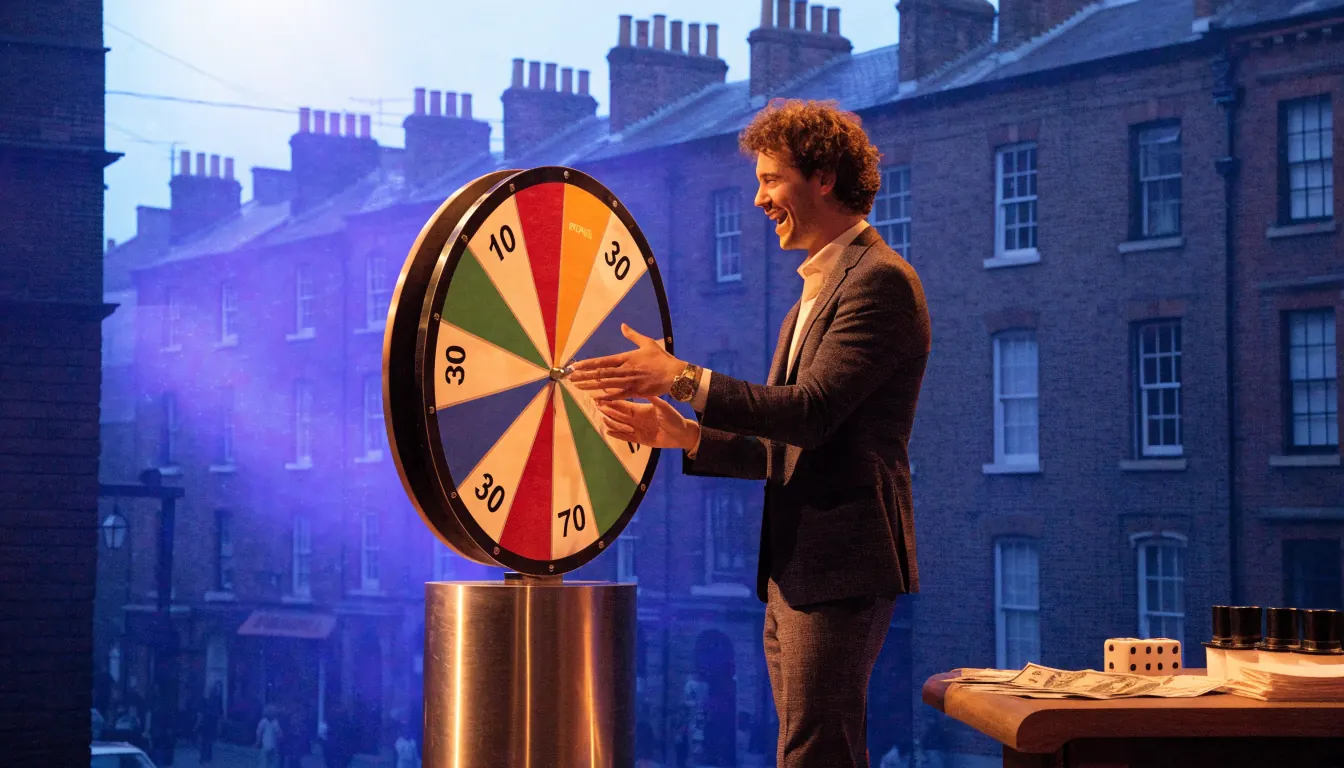
Deal or No Deal Casino UK: How the Games Work
 Available in GB
The familiar Banker-offer premise can vary by title, and access may require qualifying before play.

Table of Contents
- The Deal or No Deal Format: Qualifying and Facing the Banker
- Our top casino picks for the UK
- Playing Online in Britain: The Rules That Matter
- Megaways and Golden Box: The Changing Reels
- Deal or No Deal Slot Machines: What ‘Play’ Means Online
- Free Play: A Way to Explore, Not a Cash Offer
- Double Action: What the Name Tells You—and What It Doesn’t
- What’s in Your Box? Checking the Slot’s Details
- The Perfect Play Slot: A Separate Version to Verify
- No-Deposit Bonus Searches: Check the Offer Before You Assume
- Deal or No Deal Scratchcards
The Deal or No Deal Format: Qualifying and Facing the Banker
The name brings a familiar game-show idea to mind: a choice between accepting a Banker’s offer and carrying on. In a casino game built around that premise, the offer is part of the drama, but it is not a reliable clue to what will happen next. And the name alone does not tell you exactly how a particular game works.
One important point is easy to miss: players must qualify before they can play. That means access to the game is not necessarily immediate, and the qualification step is part of the format rather than something to assume away. The precise route to qualifying depends on the game in front of you, so look at its own description instead of relying on the title or on what you remember from the television show.
That distinction matters because “Deal or No Deal” is a theme, not a guarantee that every branded game follows an identical script. A Deal or No Deal slot may borrow the familiar idea of a Banker making an offer, yet the way that idea is presented can differ from one title to another. Treat each game as its own product. The title gives you a starting point; it does not supply the rules.
French Roulette Online Casinos in the UK: Rules
The Banker’s offer is not a forecast
The Banker is the format’s central bit of theatre. An offer puts a decision in front of you, but it should not be read as a promise, a prediction or a signal that a particular result is more likely. A specialist review of one game reports that Banker offers can vary greatly according to the random number generator, or RNG. That is a report about that game, not a dependable description of every Deal or No Deal title.
The practical takeaway is modest: do not infer a pattern from a single offer. If an amount looks generous, that appearance alone does not establish what the next outcome will be. If it seems disappointing, that does not tell you that the game is due to improve. The offer and the result are not a conversation with the game. It is still a randomised product, and the offer’s role is to create a choice within its particular format.
Fast Payouts at UK Online Casinos: What to Check
This is where the television association can mislead. A viewer may remember the tension of weighing an offer against what could remain unseen. A casino game can use similar language and atmosphere, but you should not assume that its decision points, qualification rules or outcomes reproduce the show. The resemblance is a theme to recognise, not a rulebook.
Read the game in front of you
Before treating any Deal or No Deal slot as the version you have in mind, check the title and its own information. Is it a slot using the Banker idea, or are you expecting the broader game-show format? What does the description say about qualifying and the choices that follow? Those are more useful checks than relying on a shared logo or familiar wording.
The same caution applies when comparing Deal or No Deal slot games. A similar name does not establish that two titles have the same structure, and one game’s account of Banker offers should not be carried over to another. Even where the theme is recognisable, the details belong to the individual title. I would keep the label and the mechanics separate: the first helps identify the family of games; the second tells you what that particular game actually asks you to do.
If you cannot find a clear explanation of qualification or the Banker decision in the game’s own information, do not fill in the gaps from memory. The qualification requirement is real, but the method is not something to guess. Likewise, an offer’s presence does not make every game with the brand interchangeable.
That is the useful way to approach the Deal or No Deal format: recognise the game-show-style tension, then check the individual game rather than assuming the title settles everything. Qualifying comes first; the Banker’s offer is a decision point, not a forecast. The name is only the beginning.
DO
- Check the specific game title and its information
- Verify the operator’s licence on the UKGC register
- Read the actual rules and paytable of the game in front of you
DON’T
- Assume all branded games follow the same rules
- Rely on memory or television show formats to understand mechanics
- Assume an offer or feature is available just because it is mentioned elsewhere
Our top casino picks for the UK
- SpinFormulaBonus: 550% Up To £15,000 + 550 FS · Payout speed: 1-3 business days
- WinBeastBonus: €5000 + 500 FS + €650 Freebet · Payout speed: 1-3 business days
- DieselwinBonus: Welcome Pack 250% up to £4000 + 200 FS · Payout speed: 1-3 business days
- NightWinBonus: £900 + 400 free spins · Payout speed: 1-3 business days
- ChanzeBonus: Slots Welcome Bonus #1 200% up to €500 · Payout speed: 1-3 business days
- Revery PlayBonus: 100% up to€1,000+ 100 FS · Payout speed: 1-3 business days
- AmunbetBonus: Join now and get 450% up to 2,700 GBP + 450 FS · Payout speed: 1-3 business days
- SlotoSportBonus: 500% up to £ 10 200+ 777 FS · Payout speed: 1-3 business days
- NightLuckBonus: Welcome Pack + 805% Up To 6400€ + 280 FS · Payout speed: 1-3 business days
- ZombillionBonus: Welcome Pack 250% up to £4000 + 200 FS · Payout speed: 1-3 business days
Playing Online in Britain: The Rules That Matter
A Deal or No Deal title does not sit outside the rules that apply to other online gambling. In Great Britain, the regulator is the UK Gambling Commission (UKGC), which oversees commercial gambling, including online casinos. The name on a game tells you what it is called; it does not tell you whether the business offering it is authorised to serve customers here.
The distinction matters because regulation attaches to the gambling activity and the businesses providing it, not simply to the game’s branding. If you encounter a Deal or No Deal slot game online, the relevant question is whether the operator offering the game is properly licensed for the British market. A familiar title is not a substitute for that check.
Who regulates online gambling?
The UKGC is the sole regulator for commercial gambling in Great Britain. Its remit includes remote gambling offered to consumers in Great Britain, even when the equipment used to run the service is located elsewhere. So an operator cannot avoid the British licensing requirement just by hosting its systems outside the country.
Keno Online Casinos in the UK: Licensing and Checks
That is an important point when an online casino presents itself as an international service. The location of its website or technical equipment does not, on its own, decide whether it falls within the rules for offering gambling to people in Great Britain. The regulator’s concern is the service offered to those consumers.
The Commission issues operating licences to gambling businesses and personal licences to individuals who work in regulated operating roles. These are different forms of authorisation: one applies to the business, the other to relevant people working within it. A casino’s claims about a game or its catalogue do not replace the need for the operator to hold the appropriate authority.
Great Britain and the wider UK
People often use “UK” as a catch-all, but the legal framework has a territorial edge. The Gambling Act 2005 governs gambling in England, Wales and Scotland; it does not govern Northern Ireland. The UKGC’s role described here concerns Great Britain, meaning England, Scotland and Wales.
For a reader in Great Britain, the practical rule is straightforward: online gambling is legal when it is offered by a properly licensed and regulated operator. A business selling remote gambling into the British market must hold a UKGC licence, wherever it is based. The same principle applies whether the page describes a video slot, a casino game online or another form of remote gambling.
Casino Games: Slots, Live Tables and Online Play
That wording is more useful than relying on a site’s own label. “International”, “online casino” or “game room” does not establish that the operator is authorised in Britain. Nor does a game’s association with a known entertainment brand answer the licensing question. The operator is the part to assess.
What licensing does—and does not—tell you
A UKGC licence is a regulatory status for the business or individual covered by it. It is not a promise that a particular game will suit you, nor does the presence of a known slot title prove that every site displaying it is licensed. Keep those questions separate.
If you are checking a site, use the Commission’s public register to confirm the operator’s licence details before depositing. That check is more dependable than a badge or a sentence on the casino’s own page. A site may use confident wording; the register is the place to verify the status.
The UK Gambling Commission (UKGC) regulates commercial gambling in Great Britain, including remote gambling. An operator must hold a valid licence to offer services to consumers in this market.
A licence also places the operator within the British regulatory system. That is the relevant distinction between fully licenced UK slot sites and services operating outside that system. The latter do not hold a UKGC licence. A foreign address or overseas technical setup does not turn an unlicensed service into a licensed British one.
It is easy to let the game take centre stage when a page is built around a recognisable title. For regulation, though, the key detail is who offers the gambling and whether that business holds the required licence. The game’s name comes second.
A practical way to read casino pages
When a page offers Deal or No Deal online slots, look past the title and identify the operator responsible for the gambling service. Then check that business on the UKGC register. If the site does not make the operator clear, or its licensing claim cannot be confirmed, the branding itself cannot fill that gap.
I find it helps to separate three things: the game name, the website displaying it, and the company legally offering the gambling. They may appear together on one page, but they are not the same thing. The Commission’s remit is about regulated gambling activity and the licensed businesses and people involved in operating it—not a blanket endorsement of each game that appears on a casino site.
So, for online casino games in Great Britain, the framework is not complicated: the UKGC regulates commercial gambling, remote operators selling to British consumers need the relevant licence, and equipment location does not remove that requirement. Northern Ireland has a different legal position under the Gambling Act 2005. Check the operator, not just the slot label.
Aviator Casino Game UK: Licensing and Checks
Megaways and Golden Box: The Changing Reels
The word “Megaways” points to a particular reel mechanic, not a promise that every Deal or No Deal slot works alike. Deal or No Deal Megaways and Deal or No Deal Golden Box Megaways are the titles to keep separate from other branded games. If you are comparing versions, start with the full game name; a shared television theme does not establish shared reels, features or rules.
In the Megaways mechanic, changing reel layouts can create as many as 117,649 ways to win. That is a maximum, not a guarantee that every spin will show that many possible routes. A winning combination depends on the symbols shown and the game’s payline rules. To complete a win, you need between two and six matching symbols on a payline. The count can sound like the whole story, but it is only one part of how a result is formed.
A win can also set off a cascade. The symbols involved disappear, and new ones fall into their places. Those replacements may create another winning combination, which can lead to another cascade. It makes a spin unfold in stages rather than ending as soon as the first combination lands. I would read the game’s own paytable and rules before treating a large ways-to-win figure as a guide to likely outcomes. It describes possible combinations, not how often a player wins.
Megaways Maximum Ways 117,649
Winning Combination 2 to 6 matching symbols
Feature Detail Cascading reels
UK Restriction No autoplay permitted
The Golden Box title belongs in the Megaways conversation, but the name alone should not be used to fill in details. “Golden Box” and “Golden Case” are easy to muddle when you are scanning game names; check the exact title shown by the game rather than assuming that similar wording means the same release. The Big Hit Megaways is another distinct title name, not a reason to transfer Golden Box details to it. A title match matters.
There is also an autospin feature in the described Megaways mechanic, allowing as many as 100 automated spins to be set up. That feature needs an important UK qualification: online slot autoplay is not permitted in Britain. A UK-facing, licensed version must comply with local rules, so the feature should not be treated as something you can use at a fully licenced UK slot site. The game may describe an autospin setting, but a description is not permission to use it here.
That distinction is useful when reading a review or looking for a demo. A reviewer may be describing a version, interface or market that is not the one available to you. Check the full title and the rules displayed in the game, and do not assume that demo access, free play or a particular feature is available just because a page mentions it. Those details can depend on the specific release and operator; the title by itself settles none of them.
For a quick comparison, keep to what the Megaways label actually tells you: a changing-reel mechanic, a possible maximum of 117,649 ways, wins formed from two to six identical symbols on a payline, and cascades after winning symbols disappear. Autospin is a separate feature, and UK rules make its use a different matter. Clear enough. Just not interchangeable.
Monopoly Live Casino in the UK: How It Works
Deal or No Deal Slot Machines: What ‘Play’ Means Online
When people talk about a Deal or No Deal slot machine, they may mean a physical machine in a venue or an online slot with the same branding. The phrase does not identify one fixed game. Online, it is better understood as a broad label: the title and its rules depend on the particular version, not simply on the words Deal or No Deal.
That distinction matters if you are trying to find a specific game. A familiar name or television-show theme does not tell you whether an online title is the one you have in mind, or whether its features match another game carrying the brand. Check the full title and the game information shown by the operator before drawing conclusions. Branding is not a rules sheet.
“Play online” also describes a route to a game, not a promise that every version can be found at every casino. I would not assume a title is available because it appears in a general list, an old review, or a discussion elsewhere. Availability can depend on the operator and the particular product it offers. If you are checking a site, use its own current game catalogue and make sure the title matches.
The words “slot machine” can add to the confusion. Online, the game is presented on a screen rather than as a cabinet in a venue; the shared label does not make the two formats interchangeable. Nor does it mean that all online Deal or No Deal games work alike. Treat each title as its own product, and read its rules rather than borrowing details from another version with a similar name.
Attention Online slot machines are not identical to physical venue cabinets; for example, autoplay is not permitted in the British market.
In Britain, real-money online gambling is legal at sites holding a UK Gambling Commission licence. The Commission regulates remote gambling offered to consumers in Great Britain even when the operator’s key equipment is elsewhere. That is a practical distinction when you are deciding what “online” means: a site’s location alone does not establish whether it is authorised to serve customers here. A UK-facing site should hold the relevant licence.
If you are considering a real-money game, check the operator’s licence on the Commission’s public register before depositing. The operator must verify your age before allowing a deposit, and online gambling is for adults aged 18 and over. These are conditions of the regulated setting, not features of a particular Deal or No Deal title.
There is also a difference between choosing a game and choosing how it runs. In Britain, online slots cannot use autoplay, and each game cycle must last at least two and a half seconds before the next can begin. So an online slot machine is not a physical cabinet reproduced exactly on a screen; its operation sits within rules that apply to remote gambling here.
The sensible starting point is the exact game name, followed by the game information and the operator’s regulatory status. Don’t use one Deal or No Deal title as a shortcut for another. Same label, different game.
Classic Slots Online in the UK: How They Work
Free Play: A Way to Explore, Not a Cash Offer
“Free play” can mean different things when you see it attached to a Deal or No Deal slot. You might be looking for a version that can be tried without staking money, or for free spins offered as part of a promotion. Those are not interchangeable. The wording alone does not tell you which one is meant, or whether either is available for a particular title.
I’d start by identifying the exact game rather than assuming every Deal or No Deal-branded slot has the same options. A shared name is not proof that two games work alike, and it does not establish that either has a free-play mode. The title may be familiar; the details still need checking.
If you want to try a game without wagering, look for clear information on the specific game and the site displaying it. Check whether the page explicitly says it offers a free version, and whether the game itself is identified by its full title. If that information is not there, don’t treat a search result, a promotional phrase or a game’s branding as confirmation. Better to pause than to guess.
Free spins are a separate point to check. The phrase can refer to an offer, rather than access to a game in a no-stake mode. It does not, by itself, explain how an offer works, whether it applies to a particular Deal or No Deal title, or whether it is currently available. Read the actual offer wording before deciding what it means. A label is not the terms.
Understanding Free Play
“Free play” can refer to accessing a game without staking money or to promotional free spins. These are not the same thing, and availability depends on the specific title and operator terms.
There is also a practical difference in what you can learn. A free version, if offered, may let you see how a particular game behaves without making a cash stake. It does not establish what a real-money session would involve, and it is not a promise of a cash return. Free spins, where an offer exists, are a promotion question, not simply another name for trying a game without staking.
So when you see a Deal or No Deal game described as free, pin down what “free” refers to: the game access, a promotional feature, or just loose wording on a page. Then confirm the exact title and read the details shown where it is offered. If those points are unclear, there is no sound basis for assuming you can play it for free.
That distinction keeps the choice simple. Looking to explore a game and looking for free spins are different intentions, and neither should be inferred from the brand name alone. Check what is actually being offered; if the page does not make it clear, leave it there. No guesswork.
Double Action: What the Name Tells You—and What It Doesn’t
“Double Action” is a title, not a reliable description of how a slot plays. The wording may sound like a clue to a feature, but it does not tell you what happens on the reels, how wins are calculated or whether the game includes a bonus round. Those details belong to the individual game, not to the phrase on its cover.
Live Baccarat Online Casinos in the UK: What to Check
That distinction matters when you are looking at a Deal or No Deal Double Action slot review. A useful review should identify the exact game and explain its mechanics from information tied to that version. The title alone cannot establish its payout figures, volatility, symbols or special features. Nor should details from a differently named Deal or No Deal slot be carried across as though every game in the range works alike.
I would treat the name as a starting point, then check the game’s own information before drawing conclusions. Look for the full title and provider, and see whether the rules or paytable shown for the game describe the features being discussed. If a review makes a claim about a feature, the claim should be traceable to that specific version. A shared brand is not enough.
The same care applies when you are trying to find a casino offering the title. A search result, game catalogue or review does not by itself establish that a particular casino currently carries it. Availability can depend on the operator and the version listed, so check the casino’s own game information rather than assuming the name is present because it appears elsewhere.
For real-money play in Britain, the operator must hold a UK Gambling Commission licence to serve customers here. That is a separate question from whether it offers this particular game: a licence does not confirm a title is in the catalogue, and a title listing does not establish the operator’s regulatory status. Check both independently.
There is no sensible shortcut from “Double Action” to a verdict on the game. The exact version and its published rules have to do the talking. Names are cheap.
Important Distinction
Always verify the specific game title and the operator’s regulatory status rather than relying on the brand name alone.
What’s in Your Box? Checking the Slot’s Details
A title such as Deal or No Deal: What’s in Your Box? is specific enough to deserve its own checks. The name alone does not tell you the game’s RTP, how its rounds work or what features it includes. I wouldn’t carry figures across from another Deal or No Deal game just because the branding looks familiar.
RTP is a game-specific figure describing theoretical returns over extended play; it is not a promise about what you will receive in a particular session. That leaves no sound basis for describing its payout profile or calling it a close match to another version. Short answer: don’t guess.
If you come across an RTP figure, check that it belongs to What’s in Your Box? itself, rather than to a different game with the same franchise name. The same goes for feature descriptions: a bonus, symbol or round mentioned on a page for another title should not be assumed to appear here. Branding is not a rules sheet.
When a game is available to view, its in-game information panel is the sensible place to start. Compare the displayed title with the one you intend to play, then look for the game rules and any RTP information shown there. If the title or details do not line up, treat the information as belonging to something else. A page that gives a figure without clearly identifying the exact version is not enough to rely on.
I’d also separate a game’s general description from claims about how often it pays or what a feature might return. Those are different questions, and a familiar name answers neither. If you cannot find details attached to the exact title, the honest conclusion is simply that its RTP and mechanics remain unconfirmed. Better that than borrowing numbers from a neighbour.
Casino Dice Games in the UK: Formats and Checks
The Perfect Play Slot: A Separate Version to Verify
“Perfect Play” is a title to identify carefully, not a set of rules you can infer from the Deal or No Deal name. The wording alone does not tell you who made the game, which version a listing refers to, or what its features are. I would start with the full title shown on the game’s information screen, then compare it with the title used in the casino’s lobby.
That distinction matters because a shared brand does not mean shared mechanics. Deal or No Deal Megaways and Deal or No Deal Golden Box Megaways have named features associated with their versions; those details should not be carried over to a Perfect Play title without confirmation. Nor should you assume its return-to-player figure, volatility, bonus rounds or wagering rules from a different game with the same brand.
If a casino page describes a Perfect Play game, look for the exact game name and provider in its rules or information panel. If the page gives only a broad brand label, it may not be enough to pin down which title is being offered. The game’s own information is a better reference than a thumbnail or a short lobby description.
I would also keep the title separate from other Deal or No Deal searches. “Perfect Play” does not, by itself, indicate a free-play mode, a promotion, a scratchcard or a particular slot format. Those are different questions, and the name does not answer them.
Is every Deal or No Deal game the same?
No, the name is a theme rather than a guarantee of identical rules, features, or mechanics. Each title should be treated as its own product.
Can I use the autospin feature in the UK?
No, online slot autoplay is not permitted in Great Britain; licensed versions must comply with local rules.
How can I check if an operator is legal?
You should use the UK Gambling Commission’s public register to confirm an operator’s licence details before depositing.
Before relying on a figure or feature claim, make sure it belongs to the exact Perfect Play version in front of you. A review of another branded game cannot fill that gap. If the casino does not identify the version clearly, you have no sound basis for treating its details as interchangeable with another title.
A name is a starting point, not a specification.
No-Deposit Bonus Searches: Check the Offer Before You Assume
A no-deposit bonus is a promotional offer, not simply another name for free play. If you are looking for one connected with Deal or No Deal, treat it as a question about a particular operator’s current promotion. The game title alone does not establish that an offer exists.
Check the operator’s own promotion page and the terms attached to the offer before you act on a banner, search result or third-party mention. Confirm that the promotion names the game or applies to it, and read what the offer actually permits. Do not assume that a headline tells you the full conditions. If the terms are unclear or the promotion cannot be found on the operator’s site, do not treat it as confirmed.
This is different from trying a game in free-play mode. Free play refers to exploring a game without treating the session as a cash promotion; a no-deposit bonus is an offer from an operator, with its own terms. One does not prove that the other is available. Nor does a general bonus advertisement necessarily apply to a particular Deal or No Deal title.
For real-money gambling in Britain, the operator must hold a UK Gambling Commission licence. Online gambling is for people aged eighteen and over, and operators must verify a customer’s age before allowing deposits. Check the operator and the promotion directly rather than relying on a copied offer description. A promotion can change, and an old mention is not evidence that it remains active.
Live Blackjack Online Casinos in the UK: What to Check
I would not plan around a bonus until I had read the actual offer and could see that it applied to the game I intended to play. If there is no clear, current offer to inspect, the sensible assumption is simply that you have not confirmed one. No bonus should be treated as guaranteed value or as a reason to deposit.
Deal or No Deal Scratchcards
A scratchcard carrying the Deal or No Deal name should not be assumed to work like a slot, or like another product with the same branding. The title alone does not tell you who issues it, how a play is made, how prizes are determined or whether a particular version is available to you.
That distinction matters online. A page may use familiar branding while referring to a different product from the game-show-style format or the slot versions. Before treating a listing as an actual scratchcard, check that it identifies the product clearly and provides its own rules. If those details are absent, there is no sound basis for guessing how it works. I would stop there rather than fill in the blanks from another Deal or No Deal game.
The rules should explain what counts as a winning result and how any prize is awarded. Check that the information applies to the exact scratchcard shown, not simply to a similarly named slot or promotion. A shared title is not proof of shared mechanics. Nor does it establish that a scratchcard is currently offered by a particular operator.
For a real-money product, the operator and the product details matter as much as the name. Use the UK Gambling Commission’s public register to check an operator’s licence before depositing. A familiar brand, a search listing or a page that looks like a scratchcard is not a substitute for that check.
I can’t confirm rules, availability or prizes for a Deal or No Deal scratchcard from the name alone. So treat any claim about its gameplay or rewards as unconfirmed unless the product’s own information spells it out. No borrowed slot rules. No guessed prizes.
Created by the "Casino not on Gamstop" editorial team.